Talk with a specialist: info@KernowControls.co.uk | 01326 712093

Carbon Reduction Plan FY2025/26

Report Overview

This Carbon Reduction Plan has been produced in accordance with the guidance issued by the UK Government Cabinet Office under Procurement Policy Note (PPN) 06/21: Taking Account of Carbon Reduction Plans in the Procurement of Major Government Contracts.

Building Management Systems (BMS) play an important role in improving building efficiency, reducing energy consumption and supporting the transition to Net Zero. Through the design, maintenance and optimisation of BMS solutions, Kernow Controls Limited supports its customers in reducing operational energy use and associated carbon emissions.

As a growing business, Kernow Controls Limited recognises that operational activity, project delivery, procurement requirements and workforce size will naturally influence reported values over time. As projects, staffing levels and operational requirements change, annual values may increase, decrease or fluctuate.

The Company therefore focuses on improving efficiency, reducing unnecessary waste and making informed operational decisions, rather than pursuing reductions that could adversely affect service quality or business performance.

Commitment To Achieving Net Zero

Kernow Controls Limited is committed to achieving Net Zero greenhouse gas emissions by 2050.

Baseline Emissions Footprint

Baseline emissions are a record of the greenhouse gases that have been produced in the past and prior to the introduction of any strategies to reduce emissions. Baseline emissions are the reference point against which emissions reduction can be measured.

Baseline Year Emissions 2024

No emissions reporting was undertaken prior to the establishment of the 2024 baseline year. This baseline provides the reference point against which future emissions reductions will be measured.

Note: Kernow Controls Limited is registered as a Lower Tier Waste Carrier.

  • Scope 1 – Direct Emissions = 0.0 tCO₂e
  • Scope 2 – Purchased Energy =  1.24 tCO₂e
  • Scope 3 – Indirect Value Chain = 6.96 tCO₂e
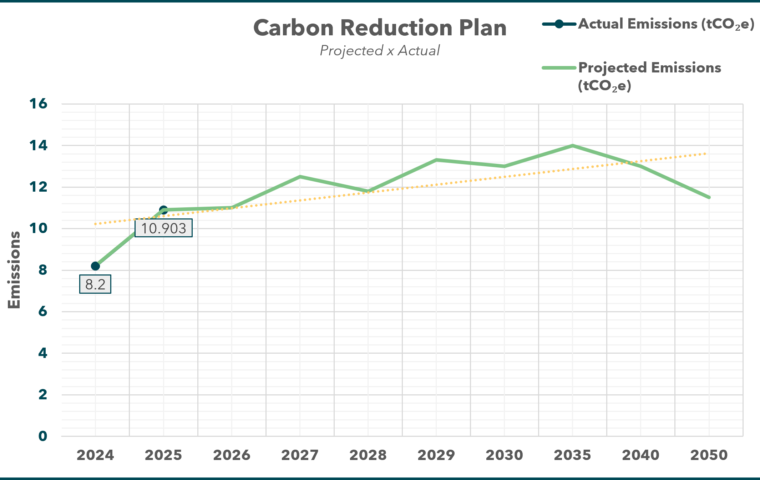
  • Total Emissions = 8.20 tCO₂e

Emissions Reporting for Fiscal Year 2025/26

The table below presents the emissions calculations for FY2025/26 based on available operational data and the UK Government Greenhouse Gas Reporting Conversion Factors 2026.

  • Scope 1 – Direct Emissions = 2.079 tCO₂e
  • Scope 2 – Purchased Energy = 0.843 tCO₂e
  • Scope 3 – Indirect Value Chain = 7.981 tCO₂e
  • Total Emissions = 10.903 tCO₂e

Note: Direct comparison between the 2024 baseline and FY2025/26 reporting period should be interpreted with caution, as reporting methodologies and available emissions data differed between the two reporting exercises.

Emissions Reduction Targets

In order to continue progress toward achieving Net Zero, Kernow Controls Limited will continue to monitor, measure and manage operational emissions while seeking opportunities to improve efficiency, reduce unnecessary travel and minimise waste.

The Company’s objective is therefore to improve operational efficiency, minimise unnecessary waste and reduce environmental impacts where reasonably practicable, whilst continuing to deliver quality services, long-term value and positive outcomes for customers, employees, suppliers and other interested parties.

Progress against this objective is shown in the graph to the left of this screen.

Kernow Controls Limited recognises that some operational impacts will remain unavoidable. The Company’s approach is therefore to focus on continual improvement through efficient working practices, reduced travel, increased use of remote technologies, responsible procurement, supply chain engagement and long-term operational sustainability, while remaining responsive to evolving technologies and other practical measures that improve efficiency, support sustainable growth and deliver value.

Completed and Ongoing Carbon Reduction Initiatives

The following environmental management measures have been ongoing or completed since 2010:

INITIATIVE CARBON REDUCTION BENEFIT
Remote monitoring, diagnostics and IoT-enabled BMS solutions Reduces unnecessary travel and site attendance through remote support and problem resolution
Local recruitment and regional engineer coverage Provides quicker response times and reduces travel distances
Flexible and hybrid working arrangements Limits commuting and office resource requirements where practical
Cloud-based systems and digital working practices Reduces paper use, printing and administrative overhead
Local sourcing, planned travel and shared journeys where appropriate Avoids unnecessary travel and transportation activity
Packaging reuse and responsible waste management Reduces waste generation and supports recycling activities
Business process automation and workflow improvements Streamlines administration and removes inefficiencies
Energy-efficient BMS solutions for customers Helps customers improve building performance, increase energy efficiency and reduce costs

Future Initiatives Toward Carbon Reduction

The Company will continue to review and implement additional measures where appropriate, including:

INITIATIVE TARGET OUTCOME
Improve energy efficiency and review electricity procurement arrangements Promote efficient energy use and control operating costs
Expand remote support and remote meeting capabilities Maintain service levels while reducing the need for site attendance and face-to-face meetings
Continuing to improve office efficiency Minimise avoidable consumption of electricity, materials and resources
Work with suppliers that demonstrate responsible business practices Strengthen sustainable procurement and supply chain resilience
Improve journey planning and vehicle utilisation Better coordination of travel, scheduling and site activities
Review vehicle options as technology and operational requirements develop Ensure future vehicle decisions remain practical and fit for purpose
Increase staff awareness of efficient working practices Promote good working practices and responsible use of company resources
Continue monitoring and reviewing operational performance Provide meaningful data to support planning, review and future decision-making

Sources

  • Greenhouse Gas Reporting: Conversion Factors 2026

https://www.gov.uk/government/publications/greenhouse-gas-reporting-conversion-factors-2026

  • UK Government Conversion Factors for Company Reporting

https://www.gov.uk/government/collections/government-conversion-factors-for-company-reporting

  • Procurement Policy Note 06/21

https://www.gov.uk/government/publications/procurement-policy-note-0621-taking-account-of-carbon-reduction-plans-in-the-procurement-of-major-government-contracts

  • GHG Protocol Corporate Accounting and Reporting Standard

https://ghgprotocol.org/corporate-standard

Prepared by: Michelle Maas, Business Support Manager

Let’s talk about how we can help make your facility energy efficient

Get in touch >

System Partners and Solutions